Best Cutting Board for Japanese Knives (2026): Protect Your Edge
The wrong board ruins a Japanese knife's edge in weeks. We break down end-grain, hinoki, rubber, and HDPE picks to protect your investment in 2026.

Editorial Review
Independent, research-driven reviews by our editorial team
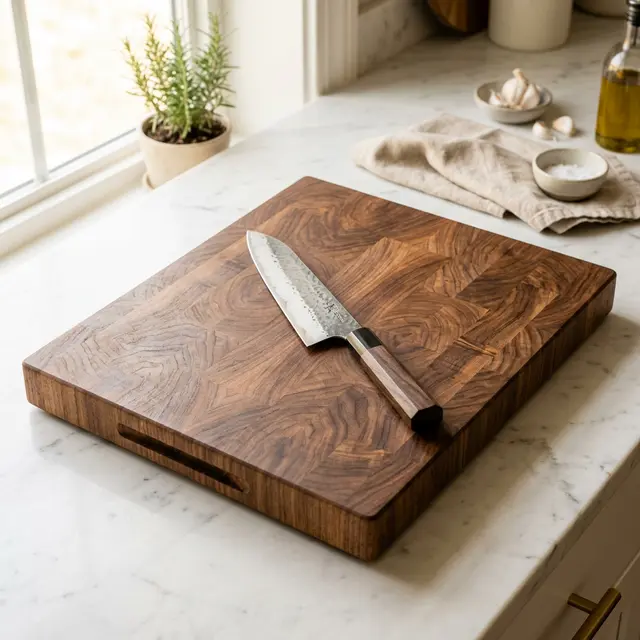
Table of Contents
Affiliate Disclosure: We may earn a commission if you purchase through our links. This doesn't affect our reviews.
Disclosure: This page contains affiliate links. If you purchase through them, we earn a small commission at no extra cost to you.
Choosing the best cutting board for Japanese knives is not an aesthetic decision — it is a metallurgical one. Japanese knives are hardened to 60–67 HRC and sharpened to edge angles as acute as 10–15°. That combination produces extraordinary sharpness, but also brittleness: the thinner and harder the edge, the more vulnerable it is to the surface it strikes.
Cut on bamboo, glass, or a hard plastic board even a few times, and you will feel the difference. Cut on the right end-grain hardwood or professional rubber board and you extend the time between sharpenings from weeks to months.
This guide covers why board material matters more than most people realize, how to choose the right surface for your specific knife and workflow, and the best options at each price point in 2026 — including some that the mainstream "best cutting board" lists routinely overlook.
Why Japanese Knives Demand a Different Board
Most Western knives are made at 56–58 HRC with a 20–25° included edge angle. They are relatively robust: the edge rolls rather than chips, and harder boards slow them down rather than destroy them. Japanese knives work differently.
At 60–67 HRC and 12–20° inclusive, the geometry that creates their extraordinary sharpness also means there is less steel supporting the very tip of the edge. According to the materials science reviewed at Japanese Knife Lab, when a hard surface reflects cutting force back into a brittle high-carbon edge, the result is micro-chipping — tiny fractures invisible to the naked eye that progressively destroy the edge geometry.
The physics of what happens at the contact point determines whether your board preserves your knife or wears it down:
- Absorbent, fiber-based surfaces (end-grain wood, hinoki, rubber composite): the knife edge slips between fibers or deforms the surface elastically. Force is absorbed. The edge is redirected, not resisted.
- Hard, reflective surfaces (bamboo, glass, ceramic, stone, marble): the knife edge strikes a surface that does not yield. The elastic rebound force travels directly back into the blade. Micro-chipping begins immediately.
The practical test: press your thumbnail into the board with moderate force. If it barely leaves a mark, the board is too hard for fine Japanese steel.
Cutting Board Materials: Ranked for Japanese Knives
| Material | Janka / Hardness | Edge Impact | Verdict |
|---|---|---|---|
| Hinoki (Japanese cypress) | Very soft (~320 lbf) | Minimal | ✅ Gold standard for traditional use |
| End-grain maple / walnut | Moderate (1450–1010 lbf) | Low | ✅ Best balance of durability + protection |
| Rubber composite (Hasegawa / Asahi) | Engineered soft | Minimal | ✅ Professional standard — excellent |
| HDPE plastic (thick, ≥¾") | Moderate | Low–moderate | ✅ Good hygienic alternative |
| Edge-grain hardwood | Moderate–high | Moderate | ⚠️ Acceptable; less ideal than end-grain |
| Teak | High + silica | Moderate–high | ⚠️ Generally avoid; some processed variants OK |
| Thin polypropylene | Moderate | Moderate–high | ⚠️ Use cautiously; no shock absorption |
| Bamboo | High + silica resins | High | ❌ Avoid — abrasive on fine edges |
| Glass / ceramic / stone / marble | Extreme | Extreme | ❌ Never — immediate edge damage |
The 6 Best Cutting Boards for Japanese Knives in 2026
1. Best Overall: John Boos R-Board Maple End-Grain
The John Boos maple end-grain board remains the benchmark for Western-made wooden boards. The tight, upright end-grain surface lets knife edges slip between wood fibers rather than across them — the essential mechanism for edge preservation.
The 2.25-inch thickness is key. Thinner end-grain boards (under 1.5 inches) flex under daily use and are prone to warping over time. The Boos construction is glued under pressure with food-safe adhesive, and the maple species choice matters: hard maple (Acer saccharum) sits at around 1,450 lbf on the Janka scale — dense enough to resist deep scoring, soft enough to absorb blade impact without reflecting it.
The board also demonstrates measurable "self-healing": because the blade passes between fibers rather than severing them, the fibers compress and partially spring back over time. This is not magic — it is the mechanical property of end-grain orientation versus edge-grain.
Specs:
- Size: 18"×12"×2.25" (several sizes available)
- Material: Hard maple end-grain
- Construction: Glued edge-grain blocks, end-grain up
- Origin: USA
- Warranty: 1-year manufacturer warranty
Who it's for: Home cooks with a dedicated prep station who want the finest Western-made end-grain board for daily use.
Considerations: Requires monthly oiling with food-grade mineral oil. Do not soak or dishwash. At 18 lbs, it does not travel.
Check current price on Amazon →
2. Best Professional Pick: Hasegawa FRK Series Rubber Composite Board
This is the board most frequently used in professional Japanese kitchens — sushi restaurants, kaiseki counters, high-end izakayas — and it is routinely omitted from mainstream "best cutting board" roundups because it looks nothing like a wood board.
The Hasegawa FRK series uses a rigid wood-composite core bonded to a soft elastomer surface layer. The surface has precisely calibrated "give" — enough to cushion a 63 HRC blade edge without being so soft that it deforms unworkably under a heavy cleaver. As noted by Knifewear and other professional-grade knife retailers, rubber composite boards are often the top recommendation for high-carbon, single-bevel, and reactive steel knives.
The non-porous surface means no bacteria wicks into the board grain the way it can in wood. Cleanup is rapid. No oiling required. Many models are dishwasher-safe (verify your specific model). The tradeoff is aesthetics: Hasegawa boards are beige or grey slabs that look more like commercial kitchen equipment than a showpiece board — because that is exactly what they are.
Specs:
- Material: Wood-composite core + soft elastomer surface
- Construction: Bonded layered composite
- Surface: Non-porous, resurfaceable
- Maintenance: Wash with dish soap; periodic bleach for stains; air dry
Who it's for: Serious Japanese knife users, raw protein prep, anyone who values hygiene over aesthetics, professional cooks.
Considerations: More expensive per square inch than wood. Does not have the visual warmth of maple or walnut. Stains from turmeric and beets visible on light-colored boards.
Check current price on Amazon →
3. Best Traditional Pick: Hinoki (Japanese Cypress) Board
Hinoki is the traditional material of Japanese professional kitchens, and it earns that status on objective grounds. Japanese cypress is soft — far softer than maple — with a Janka rating roughly comparable to Western cedar. That softness is the point: a hinoki board yields slightly under the blade rather than resisting it, creating a cutting feel that craftspeople in Japanese knife culture describe as kiritsuke-feel — clean, responsive, and tactilely precise.
The wood's natural oils have documented mild antimicrobial properties. The light, aromatic surface is the reason sashimi and delicate vegetable prep is traditionally done on hinoki rather than harder alternatives: the knife's edge is preserved across thousands of cuts, not worn down by hundreds.
The trade-off is durability. Hinoki marks more visibly than maple and requires diligent drying (standing upright, never flat) to prevent warping and splitting. It is also softer, so deep scoring from heavy-duty tasks will accumulate faster.
Specs:
- Material: Hinoki (Chamaecyparis obtusa / Japanese cypress)
- Surface: Softwood end-grain or flat-grain
- Recommended oil: Camellia oil (traditional) or food-grade mineral oil
- Ideal for: Fish, sashimi, delicate vegetable prep
Who it's for: Japanese knife enthusiasts, sashimi and fish prep, traditionalists who want the authentic Japanese cutting experience.
Considerations: Requires careful drying and storage. Marks and scratches visibly over time. Avoid strong-flavored prep (garlic, onions) — the softwood absorbs odors more than denser wood.
Check current price on Amazon →
4. Best Workhorse End-Grain: Teakhaus Large End-Grain Teak (24"×18"×1.5")
Teak is genuinely divisive in Japanese knife circles, and for good reason: standard teak contains silica — the same mineral in sand — which acts as a mild abrasive on knife edges. However, Teakhaus sources plantation-grown teak and processes it to reduce silica content significantly. The result is a board that performs closer to maple end-grain than raw teak, though it is not equivalent.
Where the Teakhaus wins unambiguously is size. At 24"×18", it is genuinely useful for large-format prep: rolling pasta, carving a roast, processing a full head of cabbage without pieces flying off the edge. The natural oil content of teak also means it requires less frequent conditioning than maple.
This is the board to consider if you need a large working surface and cannot justify the premium of a Boos board at comparable dimensions.
Specs:
- Size: 24"×18"×1.5" (multiple sizes available)
- Material: Plantation teak end-grain
- Finish: Natural teak oils; no additional coating
- Maintenance: Less frequent oiling than maple due to natural oil content
Who it's for: Cooks who need a large prep surface and want a low-maintenance board; those who process large cuts of meat or vegetables regularly.
Considerations: 1.5" thickness is the minimum we recommend for end-grain boards. Standard (non-plantation) teak is harmful to Japanese edges; confirm Teakhaus sourcing.
Check current price on Amazon →
5. Best HDPE Plastic: Dexas Superboard HDPE (12"×18")
High-density polyethylene (HDPE) is the only plastic we can genuinely recommend for Japanese knives. HDPE is softer than most people assume — soft enough that the blade impact is partially absorbed rather than fully reflected. It is also non-porous, which makes it genuinely hygienic for raw meat and fish prep in a way that wood (which wicks bacteria into its grain) cannot match.
The Dexas Superboard is the HDPE board that consistently holds up in kitchen use: thick enough to provide real shock absorption, non-slip feet for stability, and a surface that does not scar excessively under regular use.
The trade-off versus wood: HDPE does not self-heal the way end-grain wood does, and its edge-preservation is not quite as good as a well-maintained maple board. But for households where the dishwasher is non-negotiable or where raw proteins are processed daily, it is a sensible and durable choice.
Specs:
- Size: 12"×18" (multiple sizes available)
- Material: HDPE (high-density polyethylene)
- Food safety: NSF certified
- Cleaning: Dishwasher-safe
Who it's for: Raw meat and fish prep, households requiring dishwasher sanitization, cooks who want edge-safe plastic.
Considerations: Does not self-heal. Will show knife marks over time. Not as aesthetically appealing as wood.
Check current price on Amazon →
6. Best Budget: OXO Good Grips Carving Board (HDPE)
The OXO Good Grips carving board is the most accessible HDPE option and a reliable entry-level choice. At roughly $30–$40 (verify current pricing on Amazon), it delivers juice grooves for protein prep, non-slip rubber feet, and the core benefit of HDPE: edge-safe plastic at an accessible price.
It is not as thick as the Dexas and will scar more visibly under extended heavy use. But for someone stepping up from a thin polypropylene board or a bamboo board, the OXO is an immediate, meaningful upgrade for their knives.
Specs:
- Material: HDPE
- Features: Juice groove, rubberized feet
- Dishwasher-safe: Yes
Who it's for: Budget-conscious first-time buyers, households upgrading from bamboo or thin plastic.
Considerations: Thinner than ideal for heavy daily use. Best for everyday prep rather than professional-volume cutting.
Check current price on Amazon →
How to Choose: Matching Board to Knife and Workflow
Not every Japanese knife needs the same board. Here is how to match them:
High-HRC, single-bevel, reactive steel (white steel, blue steel, AS): Prioritize softness above all. Hinoki or a Hasegawa rubber board is the correct choice. These steels are the most brittle and will punish a hard surface fastest.
High-performance stainless or semi-stainless (VG-10, SG2/R2, HAP40): End-grain maple or walnut is appropriate and durable. These steels tolerate slightly harder surfaces without immediate chipping.
All-purpose daily knife (gyuto, santoku, petty) in any steel: End-grain maple is the standard, reliable answer. HDPE is acceptable for protein-heavy prep days.
Multi-knife kitchen with both Japanese and Western knives: Use end-grain maple as the primary board. It is safe enough for Western knives and protective enough for Japanese.
Size Guide
| Board Dimensions | Best Application |
|---|---|
| Under 10"×8" | Travel or bar prep only — too small for daily cooking |
| 12"×18" | Minimum practical size for daily home cooking |
| 18"×24" | Recommended for serious cooks, large-format prep, carving |
| 24"×36"+ | Dedicated prep station, professional-level workflow |
Thickness for end-grain boards: Minimum 1.5 inches. Thicker is better: 2+ inches provides meaningfully more shock absorption and stability, and is far more warp-resistant than thin boards.
Thickness for HDPE boards: ¾ inch or more. Thin polypropylene boards (under ½ inch) have almost no shock absorption and should be avoided.
Board Maintenance: A Practical Schedule
Every use: Rinse with warm water and mild dish soap immediately after prep. Dry completely — never leave a wet wooden board sitting flat on a surface. Stand it on its edge to allow air circulation on both faces.
Monthly: Apply food-grade mineral oil liberally to all wood surfaces (top, bottom, sides). Let it soak for 20–30 minutes, then wipe off the excess. Repeat until the wood stops absorbing oil quickly between applications. A new board may need three applications in the first two weeks.
Every 3–6 months: Apply a beeswax board cream or board butter over the mineral-oiled surface. This creates a water-resistant barrier that significantly extends the life of the wood and reduces moisture-related warping.
When the board looks dry, grey, or cracked: Oil immediately, regardless of schedule.
Never: Soak a wooden board in water. Put it in the dishwasher. Set hot pans directly on it. Store it near a dishwasher vent that produces steam.
Surfaces That Will Ruin Japanese Knives
These surfaces appear in kitchens frequently. Every one of them will damage a Japanese knife edge:
Bamboo: Technically a grass, not wood. Contains silica and melamine resin binders (in laminated boards) that act as sandpaper on fine steel. A common mistake: bamboo looks natural and "knife-friendly" but is one of the worst surfaces for high-carbon edges. Kai USA, makers of Shun knives, explicitly advises against bamboo boards for their products.
Glass and ceramic plates: The hardest common cutting surfaces. A single heavy use on glass can visibly chip a 63 HRC Japanese blade. Never use a knife on a ceramic or glass surface for any purpose.
Stone and marble pastry boards: Beautiful, useful for pastry work, lethal for knife edges. Keep them away from your Japanese knives entirely.
Thin polypropylene boards: The flimsy white boards that often come as a set. They flex and slide, and provide almost no shock absorption. The edge-wear rate is meaningfully higher than on quality HDPE.
Buyer FAQ
What is the single best cutting board for Japanese knives?
For most home cooks: a John Boos or comparable end-grain maple board at least 18"×12"×1.5". For sashimi and delicate prep or for those using reactive single-bevel knives: a hinoki board or Hasegawa rubber composite. For protein-heavy prep that requires dishwasher sanitization: Dexas HDPE. There is no universal answer — the right board depends on your knife steel, prep style, and maintenance willingness.
Is bamboo safe for Japanese knives?
No. Bamboo's silica content and the bonding resins used in laminated bamboo boards make it one of the most damaging surfaces for fine Japanese steel. Even one cutting session on bamboo can visibly alter the edge of a freshly sharpened Japanese knife. This is not hyperbole — it is documented consistently by professional knife retailers and the manufacturers of premium Japanese knives.
Do I need a hinoki board, or is maple equally good?
They serve different purposes. Hinoki is softer and provides superior edge protection, but it marks and wears faster. Maple is more durable and requires less care, while still being safe for Japanese knives. Many serious Japanese knife enthusiasts use hinoki for sashimi and precision prep and maple (or a rubber board) for general cooking.
How do I know if my current board is harming my knives?
The clearest sign: your knife dulls noticeably faster than it should, or you see micro-chipping under a loupe or bright light along the edge after sharpening. A second indicator: the board makes a hard "clack" rather than a soft "thud" when you set a heavy knife handle flat on it. Hard surfaces clack; absorbent surfaces thud.
Can I use one board for both Japanese and Western knives?
Yes — an end-grain maple or walnut board is safe for both. Western knives are more forgiving, so protecting your Japanese knives is the binding constraint. Choose based on the most sensitive knife in your collection.
What oil should I use to condition my board?
Food-grade mineral oil is the standard recommendation and the safest choice — it does not go rancid, is tasteless and odorless, and is inexpensive. Camellia oil is traditional for Japanese boards and works equally well. Avoid olive oil, coconut oil, and other cooking oils: they go rancid inside the wood over time and can create off-flavors. Beeswax-based board butters are an excellent complement to mineral oil, used over the top once the wood is well-saturated.
Are rubber composite boards (Hasegawa, Asahi) worth the price?
For serious use, yes. They are the preferred choice in professional Japanese kitchens for a reason: they combine edge protection equivalent to or better than hinoki with non-porous hygiene, warp resistance, and durability that wood cannot match. The higher upfront cost reflects a board that requires no oiling, resists warping, and can be resurfaced when the surface shows wear. For home cooks who prepare fish and raw proteins regularly, they are a compelling upgrade.
The Bottom Line
The best cutting board for Japanese knives is one that absorbs cutting force rather than reflecting it back into the edge. In practice, that means:
- End-grain hardwood (maple, walnut, cherry) — the durable, beautiful, standard Western option
- Hinoki — the traditional Japanese choice for edge protection above all else
- Rubber composite (Hasegawa, Asahi) — the professional kitchen standard; the best hygienic option
- Thick HDPE — the practical alternative when dishwasher-safety is non-negotiable
The surfaces to remove from your kitchen today: bamboo boards, glass plates, marble slabs, and thin polypropylene sets.
A quality end-grain board treated with monthly mineral oil is a one-time investment that outlasts any knife it serves. Buy it once, care for it properly, and your Japanese knife will hold its edge two to three times longer between sharpenings.
External References
- Japanese Knife Lab: Cutting Board Guide — comprehensive material science breakdown of how board surfaces interact with high-carbon steel edges
- Knifewear: Choosing a Cutting Board for Japanese Knives — professional knife retailer guide covering end-grain, hinoki, and rubber composite options
Related reading on this site:
- Going to resharpen after researching your board? Our Best Combination Whetstone guide covers every grit level you need.
- Learn how sharpening frequency relates to your board choice in the Kitchen Knife Sharpening Complete Guide.
- Pairing a new board with your first Japanese knife? See our picks for Best Petty Knives and Best Nakiri Knives.
- For a deeper understanding of how board material interacts with knife steel types, see our Kitchen Knife Steel Types Explained guide.
- Comparing Japanese knife brands? Read our [TojE0722 07:24:38.454611 1796434 log.go:398] mkdir /home/openengine-runner/.gemini/antigravity-cli/brain/8c24ab51-908e-4827-a3ee-1511443b5e49: read-only file system iro vs Shun](/blog/tojiro-vs-shun-comparisE0722 07:24:38.470779 1796434 log.go:398] open /home/openengine-runner/.gemini/antigravity-cli/conversations/8c24ab51-908e-4827-a3ee-1511443b5e49.51f6369a-bd9a-40b7-8cc5-9d6bc94c07ed.tmp: read-only file system on/) head-to-head.
Nora Whitfield
Writer, Kitchenware Authority
Nora Whitfield writes Kitchenware Authority's reviews and buying guides. Every knife, pan, and appliance is vetted against maker specifications, materials and safety documentation, and the long-run experience verified home cooks report — not first-hand lab tests.
Upgrade Your Kitchen Skills
Get chef-curated gear reviews, maintenance tips, and exclusive buying guides delivered to your inbox.
Join 15,000+ home cooks. No spam, ever.