Best Kitchen Scale: Top Picks for Cooking and Baking
The best kitchen scale picks compared by capacity, resolution, tare speed, and unit modes, with a dedicated top pick for baking and precision work.

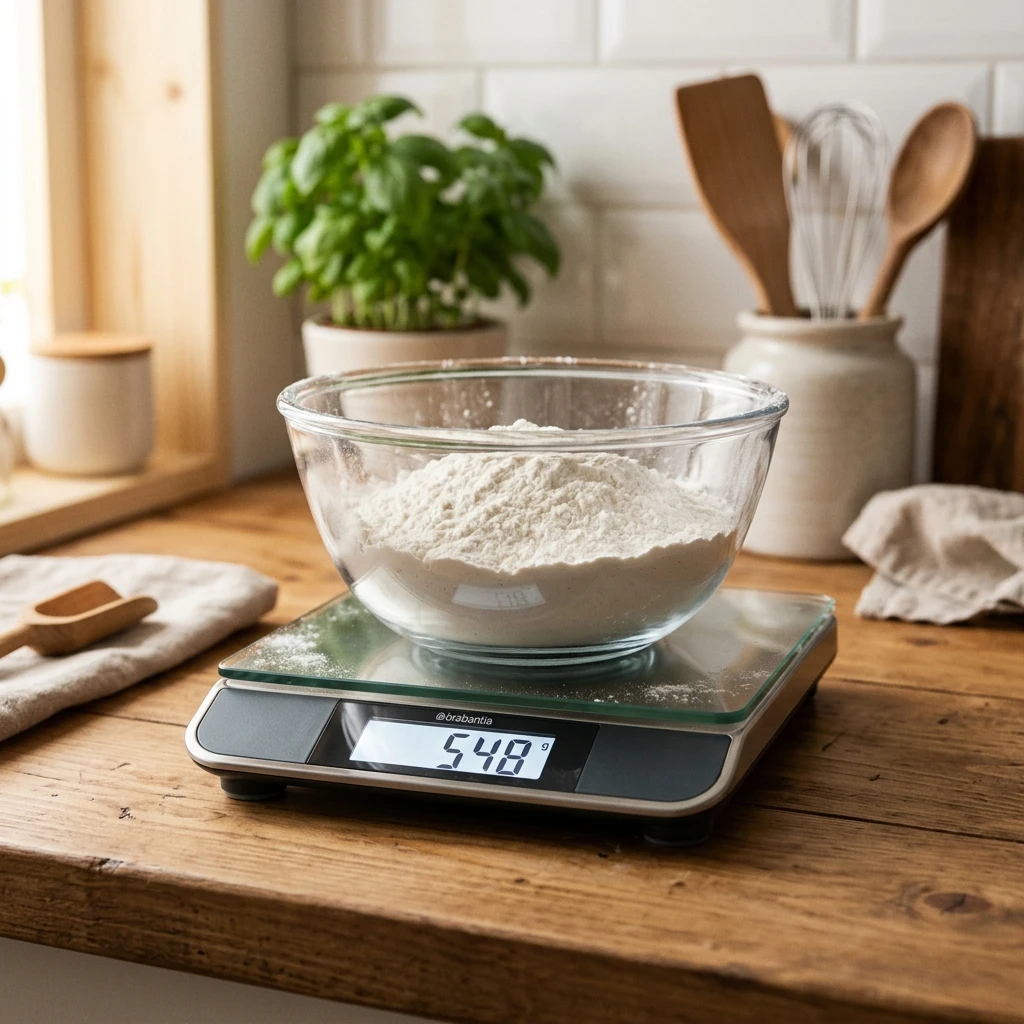
Table of Contents
Affiliate Disclosure: We may earn a commission if you purchase through our links. This doesn't affect our reviews.
Affiliate Disclosure: Kitchenware Authority is an Amazon Associate. We earn from qualifying purchases at no extra cost to you. This helps support our independent research and chef-reviewed guides.
The OXO Good Grips 11-lb Food Scale is the best kitchen scale for most home cooks and bakers, offering 11-pound capacity, 1-gram resolution, and a pull-out display that stays readable under a full mixing bowl. For dedicated baking — especially bread and large batches — the My Weigh KD-8000 is the best baking scale thanks to its 8-kilogram capacity and built-in baker's percentage mode.
Every baker runs into the same problem eventually: cups are unreliable for flour. A scooped cup and a spooned cup can differ by 20% or more, which is enough to turn a light loaf dense or a chewy cookie cakey. A kitchen scale removes that variable — 300 grams of flour is 300 grams however you load it. The picks below cover everyday cooking, budget baking, precision pastry work, and large-batch bread, followed by a full spec comparison and baking-specific guidance.
Quick Picks
| Need | Best pick | Why it fits | Price check |
|---|---|---|---|
| Best kitchen scale overall | OXO Good Grips 11-lb Food Scale | 11-lb capacity, 1-gram accuracy, easy to clean, readable under large bowls | Amazon |
| Best value kitchen scale | Escali Primo P115C | Reliable 1-gram accuracy at a lower price | Amazon |
| Best precision baking scale | Ohaus Scout SPX2201 | 0.1-gram resolution for yeast, salt, and pastry work | Amazon |
| Best large-capacity baking scale | My Weigh KD-8000 | 8 kg capacity and baker's percentage mode for bread batches | Amazon |
Our Top Picks
1. Best Overall: OXO Good Grips 11-lb Food Scale
The OXO Good Grips 11-lb Food Scale is the best kitchen scale for most home cooks and bakers. Its 11-pound (5 kg) capacity covers essentially any home recipe, and it reads in 1-gram increments across grams, ounces, and pounds-ounces. The standout feature is the pull-out display: slide it forward and you can read the weight even when a large stand-mixer bowl or proofing bucket sits on the stainless steel platform. The platform wipes clean after flour spills or sticky dough, and a simple two-button interface (unit and tare) keeps operation fast mid-recipe.
For accuracy, the 1-gram resolution is what most baking actually requires — consistent flour, sugar, and butter measurements without the swing you get from volume cups. The OXO runs on two AAA batteries and auto-shuts off to preserve them. If you want a single scale that handles everyday cooking, portioning, and the vast majority of baking, this is it.
Buy the OXO Good Grips 11-lb Food Scale on Amazon
2. Best Value: Escali Primo P115C
The Escali Primo P115C delivers dependable 1-gram accuracy and an 11-pound (5 kg) capacity at a notably lower price than the OXO. It offers the same core units (grams, ounces, pounds-ounces) and a straightforward two-button design with instant tare. The sealed control panel resists flour and spills, which matters when you are working through a messy bread or cookie session.
The trade-off versus the OXO is the display: the Primo's readout is fixed on the body, so a very large bowl can obscure it, and the platform is slightly smaller. For bakers who mostly work with standard bowls and want reliable performance without paying for the pull-out display, the Escali Primo is the best value kitchen scale on the list. It runs on two AA batteries.
Buy the Escali Primo P115C on Amazon
3. Best Precision: Ohaus Scout SPX2201
The Ohaus Scout SPX2201 is a precision balance rather than a typical kitchen scale, and that is exactly why it earns a spot. With 0.1-gram resolution across a 2,200-gram capacity, it is the right tool for the small measurements that defeat a 1-gram scale: 3 grams of yeast, 8 grams of salt, a fraction of a gram of saffron or gelatin. It supports multiple weighing units (grams, ounces, troy ounces, pennyweight, carat) and runs on an AC adapter or batteries.
This is overkill as your only scale — its capacity is lower and it is more expensive — but for pastry, chocolate, bread-hydration tuning, and recipe development where a 1-gram scale rounds away the difference between success and failure, a 0.1-gram scale is genuinely valuable. Many serious bakers keep a scale like this alongside a standard 1-gram kitchen scale.
Check the Ohaus Scout SPX2201 on Amazon
4. Best Large-Capacity Baking: My Weigh KD-8000
The My Weigh KD-8000 is the best baking scale for bread bakers and anyone working in large batches. Its 8,000-gram (17.6-pound) capacity handles big dough mixes that would max out an 11-pound scale, and it adds a baker's percentage mode — letting you weigh ingredients as a percentage of flour weight, which is how bread recipes are actually scaled.
It reads in 1-gram increments, supports grams, ounces, and pounds-ounces, and the large platform accommodates a heavy ceramic bowl or a banneton. Power comes from three AA batteries or an optional AC adapter. A separate button shield helps protect the controls from flour, a thoughtful touch for dough-heavy work. If your baking regularly involves multiple loaves, high-hydration doughs, or scaling recipes up, the KD-8000's capacity and percentage mode make it the stronger baking tool.
Buy the My Weigh KD-8000 on Amazon
The Best Kitchen Scales Compared
The table below summarizes the published specifications for each scale, drawn from the manufacturers' product pages. These are documented capabilities — we did not perform hands-on or laboratory testing — focused on the specs that matter most when choosing a kitchen or baking scale: capacity, resolution, unit modes, tare behavior, power source, and price tier.
| Scale | Capacity | Resolution | Unit modes | Tare speed | Power source | Price tier |
|---|---|---|---|---|---|---|
| OXO Good Grips 11-lb | 11 lb / 5 kg | 1 g | g, oz, lb:oz | Instant, pull-out front button | 2× AAA | Mid |
| Escali Primo P115C | 11 lb / 5 kg | 1 g | g, oz, lb:oz | Instant, sealed button | 2× AA | Budget |
| Ohaus Scout SPX2201 | 2.2 kg | 0.1 g | g, oz, ozt, dwt, ct | Instant, push-button | AC adapter or battery | Premium |
| My Weigh KD-8000 | 17.6 lb / 8 kg | 1 g | g, oz, lb:oz, baker's % | Instant, button under shield | 3× AA or AC adapter | Mid |
The deciding differences fall into two groups. For everyday cooking and most baking, the OXO and Escali Primo are nearly equivalent on paper — same 11-pound capacity, same 1-gram resolution, same unit modes — and the choice comes down to the OXO's pull-out display versus the Escali's lower price. For more specialized work, the split is by resolution and capacity: the Ohaus Scout's 0.1-gram precision serves tiny leavener and pastry measurements, while the My Weigh KD-8000's 8-kg capacity and baker's percentage mode serve large-batch bread. Electronic tare is effectively instant on all four, so what differs is button placement, not speed.
How We Selected These Scales
We did not conduct hands-on or laboratory testing for this guide. Instead, we compared published specifications and feature sets from each manufacturer's product page, then judged how those documented capabilities map onto the way home cooks and bakers actually use a kitchen scale — measuring flour, portioning dough, taring through multi-ingredient recipes, and reading the display under a large bowl.
The criteria that drove our recommendations are the same ones in the comparison table above: capacity, resolution (1-gram scales versus 0.1-gram precision scales), unit modes, tare behavior, power source, and price tier. We weighted baking-specific features — such as a baker's percentage mode and a platform large enough to hold a mixing bowl — heavily, because this guide also targets bakers searching for the best baking scale. For capacity, resolution, power source, and unit-mode details, we relied on the manufacturer pages for OXO, Escali, Ohaus, and My Weigh. Prices are dynamic (see our affiliate disclosure) and were not used as a ranking factor on their own.
What to Look For in a Kitchen Scale
Not all kitchen scales work well for every task. A scale built for portioning meals or weighing packages has different priorities than one built for adding flour to a stand-mixer bowl. Here is what matters.
Accuracy and Resolution
A kitchen scale should read in 1-gram (or 0.1-ounce) increments at minimum. For most cooking and baking — flour, sugar, butter, liquids — 1-gram resolution is enough for consistent results. For tiny ingredients such as yeast, baking powder, salt, or gelatin, a 0.1-gram resolution scale (like the Ohaus Scout) avoids the rounding error that throws off leavening. If you bake seriously, consider keeping both: a standard 1-gram scale for bulk ingredients and a 0.1-gram scale for leaveners.
Response Time
When you pour flour into a bowl, the display should update fast enough that you can stop before overshooting the target. Digital load-cell scales generally update within a fraction of a second; very cheap models can lag, which leads to over-pouring. A scale that feels sluggish mid-pour is a sign to avoid it for pour-and-stop baking.
Tare Reliability
Tare resets the reading to zero so you weigh only the ingredient, not the container. Bakers use it repeatedly — add flour, tare; add sugar, tare; add salt, tare. A reliable electronic tare holds its zero through these repeated additions. Look for a dedicated, easy-to-reach tare button rather than one buried in a menu.
Platform Size and Display
A large mixing bowl overhangs a small platform and hides the readout. The best layouts either pull the display out from under the bowl (the OXO approach) or provide a platform large enough — roughly 6 by 7 inches or bigger — to support a standard mixing bowl while keeping the numbers visible.
Capacity
Most recipes stay under 2 kilograms, but bread bakers working with large batches benefit from 5 kg (11 lb) or more. For heavy doughs and multi-loaf sessions, a higher-capacity scale like the My Weigh KD-8000 (8 kg) avoids maxing out mid-recipe.
Digital vs. Mechanical Kitchen Scales
Digital scales are the practical choice for accuracy: they offer 1-gram or 0.1-gram resolution, instant unit conversion (grams, ounces, milliliters, pounds), and a fast tare. Mechanical spring scales can lose tension over time and usually read only in coarse 10- or 25-gram steps, with no quick tare. Vintage mechanical scales look attractive on the counter but are not the right tool for precise baking.
Best Kitchen Scale for Baking
Baking is where a kitchen scale stops being optional. Volume measurements for flour vary widely — a scooped cup can differ from a spooned cup by 20% or more — and that swing changes how bread, cookies, and cakes turn out. Weighing ingredients removes the variable entirely: 300 grams of flour is 300 grams however you load it.
Accuracy for Baking
For most home baking, 1-gram accuracy is sufficient for flour, sugar, butter, and liquids. For precision tasks — measuring yeast, baking powder, salt, or gelatin — a 0.1-gram scale (such as the Ohaus Scout) is worth keeping on hand, because a 1-gram scale can round a 3-gram yeast measurement up or down enough to affect rise.
The Tare Workflow
Baking recipes often layer ingredients in one bowl: add flour, tare; add sugar, tare; add salt, tare. A scale with a reliable, fast tare lets you build a recipe without dirtying extra cups. This is the single biggest reason a digital scale outperforms volume measuring for baking.
Baker's Percentage Mode
For bread bakers, baker's percentage — expressing every ingredient as a percentage of the flour weight — is how recipes are scaled and how hydration is controlled. The My Weigh KD-8000 includes a dedicated baker's percentage mode, which makes it the best baking scale for anyone who develops or scales bread recipes regularly.
Best Kitchen Scale for Sourdough
Sourdough places extra demands on a scale. Starters are fed by equal weights of flour and water, and artisan loaves depend on precise hydration (often 70–80%). You need a scale that supports a heavy glass jar or a large ceramic bowl without hiding the display or drifting during a slow pour. For sourdough, the OXO Good Grips 11-lb scale's pull-out display and cleanable platform suit everyday starters and loaves, while the My Weigh KD-8000's higher capacity and percentage mode suit large-batch or multi-loaf bakers.
Platform Material for Baking
Stainless steel platforms are durable and easy to clean after baking — dried dough releases more readily. Glass platforms look sleek but can crack if dropped and show flour dust and fingerprints. Plastic platforms are light and inexpensive but can stain over time. For a dedicated baking scale, stainless steel or smooth ABS plastic is the most practical choice.
If you weigh only occasionally for cooking, the OXO or Escali Primo will cover everything you need. If baking — and especially bread — is a regular part of your kitchen, the My Weigh KD-8000's capacity and baker's percentage mode, paired with a 0.1-gram scale like the Ohaus Scout for leaveners, is the combination that removes measurement as a variable for good.
Nora Whitfield
Writer, Kitchenware Authority
Nora Whitfield writes Kitchenware Authority's reviews and buying guides. Every knife, pan, and appliance is vetted against maker specifications, materials and safety documentation, and the long-run experience verified home cooks report — not first-hand lab tests.
Upgrade Your Kitchen Skills
Get chef-curated gear reviews, maintenance tips, and exclusive buying guides delivered to your inbox.
Join 15,000+ home cooks. No spam, ever.